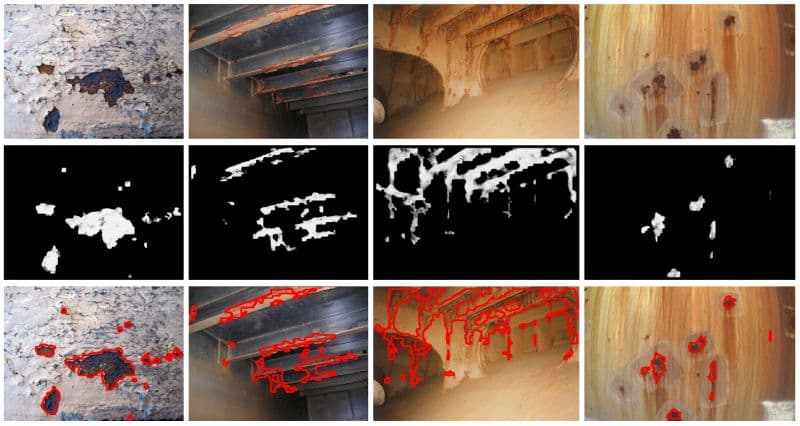
Corrosion detection using Machine Learning and Artificial Intelligence (AI) based Computer Vision Analysis through drone images of piping and equipment in industries is a novel effective approach.
Above: drone frames of corroded piping and structures on top, the corrosion mask the model predicts for each in the middle, and that mask outlined over the original frame at the bottom.
Where visual inspection stops
Visual Inspection (VI) is the most commonly used technique for external inspection, but it only treats surface defects and provides a basic understanding of equipment deterioration or coating condition. Typically, human inspectors perform this inspection manually, which is time-consuming, subjective, and reliant on the individual’s experience. Furthermore, many locations are inaccessible due to safety concerns.
What computer vision changes
To address these challenges, an AI-based Computer Vision algorithm can be developed to recognize corrosion damage in drone-captured images. Corrosion exhibits rough surface texture and specific colors within a defined spectrum. Therefore, algorithms can utilize texture analysis, color analysis, or a combination of both to detect corrosion.
This technique allows inspectors to quickly screen equipment or structures by analyzing drone images of inaccessible areas. It ensures inspector safety, reduces inspection time, and optimizes costs associated with data acquisition, processing, and documentation.