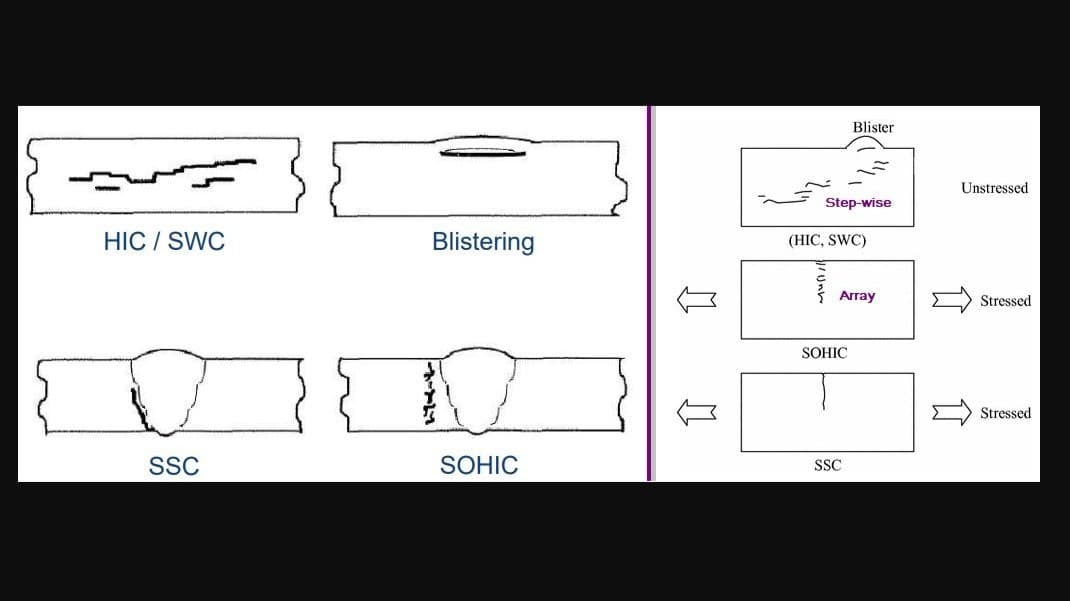
Wet H2S — hydrogen-induced cracking, stress-oriented hydrogen-induced cracking and sulfide stress cracking (HIC/SOHIC/SSC-H2S).
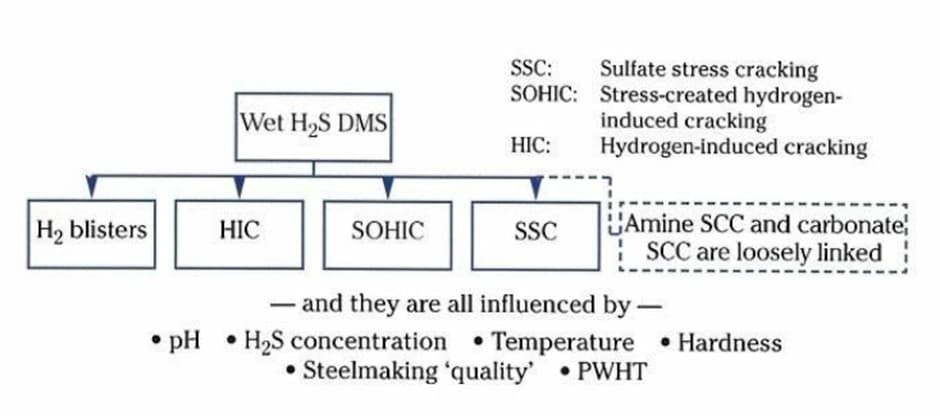
There are four main DMs associated with wet sour process streams:
- Hydrogen blistering
- Hydrogen-induced cracking (HIC)
- Stress-oriented HIC (SOHIC)
- Sulfide stress cracking (SSC)
These all are cracking damage mechanisms.
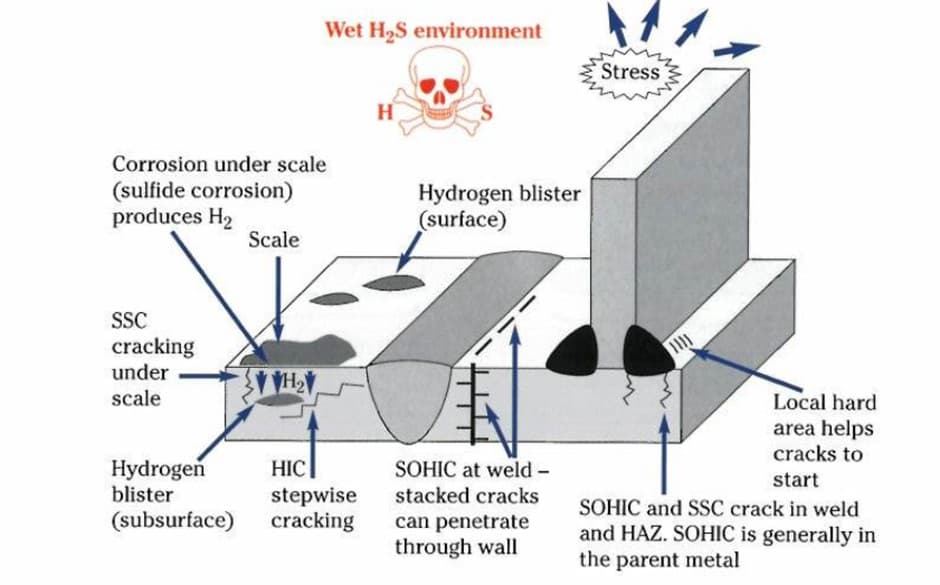
Critical factors
All these DMs are related to the permeation of hydrogen through steels. Factors include:
- H2S partial pressure
- Temperature
- Material surface hardness
- Existing material laminations and defects causing localized stresses
Hydrogen blisters
Blisters are planar hydrogen-filled cavities formed at discontinuities in the steel (e.g. voids, inclusions, laminations, sulfide inclusions). Blisters most often occur in rolled plate steels, especially those with a banded microstructure resulting from elongated sulfide inclusions. Susceptibility to hydrogen blistering, and therefore HIC, is primarily related to the quality of the plate steel (i.e. the number, size, and shape of the discontinuities).
In this regard, the sulfur content of the steel is a key material parameter. Reducing the sulfur content of the steel reduces the susceptibility to blistering and HIC. Additions of calcium or REMs that control sulfide inclusion shape control are generally beneficial. The susceptibility of the steel to blistering is directly related to the cleanliness of the steel, which is measured by sulfur content. It should be recognized that blistering is not a damage mechanism that will lead to a leak path unless it is accompanied by HIC leading to the surface.
Blistering does pose a danger to mechanical integrity when it approaches a weld that contains sufficient residual stresses to drive the HIC to the surfaces. It is in this last case, the most severe situation, that is considered when determining the susceptibility to HIC/SOHIC-H2S.
Hydrogen-induced cracking (HIC)
HIC is defined as stepwise internal cracks that connect adjacent hydrogen blisters on different planes in the metal or to the metal surface. An externally applied stress is not required for the formation of HIC. The driving force for the cracking is high stresses at the circumference of the hydrogen blisters caused by buildup of internal pressure in the blisters.
Interactions between these high stress fields tend to cause cracks to develop that link blisters on different planes in the steel. The buildup of pressure in the blisters is related to the hydrogen permeation flux in the steel. The source of the hydrogen in the steel is the corrosion reaction with wet hydrogen sulfide. Water must be present for this corrosion reaction to occur, and the resultant hydrogen flux is primarily associated with two environmental parameters, pH and the H2S content of the water.
Typically, the hydrogen flux in steels has been found to be lowest in near neutral pH solutions, with increasing flux at both lower and higher pH values. Corrosion at low pH values is caused by H2S, whereas corrosion at high pH values is caused by high concentrations of the bisulfide ion. The presence of cyanides at elevated pH can further aggravate the hydrogen penetration into the steel. Hydrogen permeation is known to increase with H2S content, e.g. H2S partial pressure in the gas phase or H2S content of the water phase. The presence of 50 ppm of H2S in the water has been sufficient to cause HIC. It can occur between ambient and 150 °C (300 °F) or higher.
Stress-oriented HIC (SOHIC)
SOHIC is defined as a stacked array of blisters joined by HIC that is aligned in the through-thickness direction of the steel as a result of high localized tensile stresses. SOHIC is a special form of HIC that usually occurs in the base material, adjacent to the HAZ of a weld, where stresses are highest due to the additive effect of applied stress (from internal pressure) and the residual stresses from welding. As with HIC, plate steel quality is a key parameter for SOHIC susceptibility. In addition, reduction of residual stresses by PWHT can reduce, but may not eliminate, the occurrence and severity of SOHIC.
The level of applied stress also influences the occurrence and severity of SOHIC. Although HIC/SOHIC is much more prominent in plate steel fabrications, it has been observed to a limited extent in steel pipe fabrications, usually in the more severe hydrogen charging environments.
Sulfide stress cracking (SSC)
SSC is defined as cracking of a metal under the combined action of tensile stress and corrosion in the presence of water and hydrogen sulfide. SSC is a form of HSC resulting from absorption of atomic hydrogen that is produced by the sulfide corrosion process on the metal surface. SSC usually occurs more readily in high-strength (high hardness) steels in hard weld deposits or hard HAZs of lower-strength steels. Susceptibility to SSC is related to the hydrogen permeation flux in the steel, which is primarily associated with two environmental parameters, pH and H2S content of the water.
Typically, the hydrogen flux in steels has been found to be lowest in near neutral pH solutions, with increasing flux at both lower and higher pH values. Corrosion at low pH values is caused by H2S, whereas corrosion at high pH values is caused by high concentrations of the bisulfide ion. The presence of cyanides at elevated pH can further aggravate the hydrogen penetration into the steel. SSC susceptibility is known to increase with H2S content, e.g. H2S partial pressure in the gas phase or H2S content of the water phase.
The presence of as little as 1 ppm of H2S in the water has been found to be sufficient to cause SSC. Susceptibility to SSC is primarily related to two material parameters, hardness and stress level. High hardness of the steel increases its susceptibility to SSC.
SSC has not generally been a concern for carbon steel base materials typically used for refinery pressure vessels and piping in wet hydrogen sulfide service because these steels have sufficiently low strength (hardness) levels. However, weld deposits and HAZs may contain zones of high hardness and high residual stresses from welding.
High residual tensile stresses associated with welds increases susceptibility to SSC. PWHT significantly reduces residual stresses and also tempers (softens) weld deposits and HAZs. A PWHT of about 621 °C (1150 °F) for 1 hour per inch of thickness (1 hour minimum) is considered effective for carbon steel. Somewhat higher temperatures are required for low-alloy steels. Control of hardness and reduction of residual stresses are recognized methods for preventing SSC as outlined in NACE RP0472.