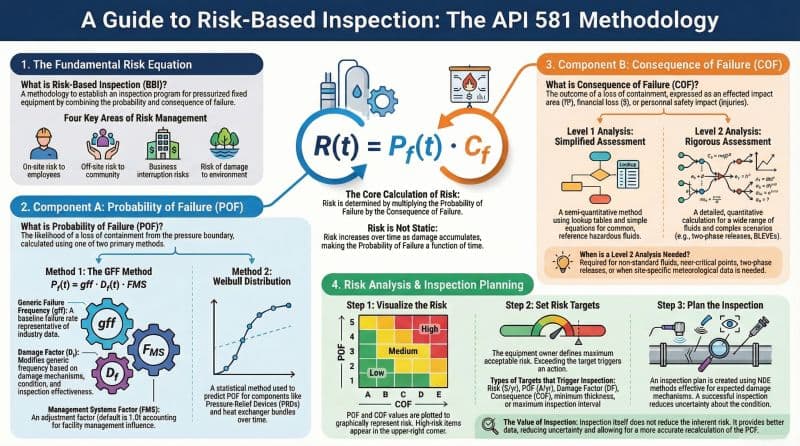
Understanding the foundational concepts of RBI (API-581) is essential for effective asset integrity management. This standard provides the semiquantitative analysis procedures needed to establish effective inspection programs.
Scope and definition
API 581 applies broadly to pressurized fixed equipment, including pressure vessels, piping, tankage, pressure-relief devices (PRDs), and heat exchanger tube bundles. Crucially, failure is defined as a loss of containment from the pressure boundary resulting in leakage or rupture.
The risk calculation
Risk, R(t), is determined by combining the Probability of Failure, Pf(t),
with the Consequence of Failure, Cf.
- POF (
Pf) — calculated using the Generic Failure Frequency (GFF) method. This formula incorporates the Damage Factor, which accounts for specific damage mechanisms (like thinning or SCC), and the Management Systems Factor (FMS). POF is time-dependent as damage accumulates. - COF (
Cf) — quantifies the potential impact of a failure, covering on-site safety, off-site community risk, business interruption, and environmental damage. Consequences can be expressed in terms of area, financial value, or injuries.
Management and inspection value
RBI is a critical tool for Risk Management, allowing owner-operators to focus inspection efforts on the small percentage of components that concentrate the highest unit risk (found in the upper right-hand corner of Risk Matrices).
The value of inspection lies in reducing uncertainty:
- Inspection action itself does not reduce the inherent risk.
- However, inspection provides improved knowledge of the component’s state,
reducing uncertainty and thereby lowering the calculated POF,
Pf(t, IE).
Mitigation strategies
- If risk is POF driven, mitigation should favor inspection-based methods.
- If risk is COF driven, mitigation must favor engineering or management methods (like reducing inventory).
A strong RBI program ensures informed decision-making regarding inspection frequency, scope, and NDE techniques.