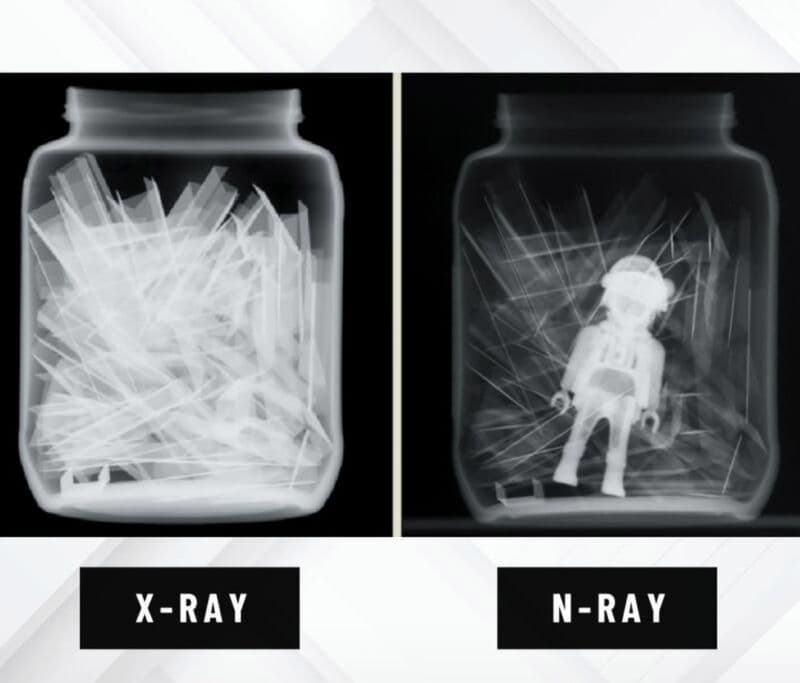
Neutron-based techniques are proving transformative in detecting Corrosion Under Insulation (CUI), a long-standing challenge in the energy sector where moisture and corrosion often develop unnoticed beneath metallic cladding. The well-known ASNT “jar comparison” vividly illustrates this principle: while X-rays emphasize dense materials like glass, neutron (N-ray) imaging penetrates to reveal the hidden plastic toy inside by interacting with hydrogen-rich substances. This striking difference underscores the critical advantage and importance of neutron-based technologies for corrosion detection.
Why X-ray radiography misses CUI
Conventional X-ray radiography interacts with electron density and thus excels at identifying cracks, inclusions, or wall thinning in metals. However, it cannot detect water ingress, wet insulation, or hydrogen-based corrosion products that initiate CUI. Neutron Radiography, in contrast, interacts with atomic nuclei and is highly sensitive to light elements such as hydrogen and oxygen. This allows N-rays to penetrate metallic jackets while clearly highlighting areas containing moisture or corrosion — inverting the imaging contrast, where metals appear transparent and hydrogen-rich regions stand out vividly.
Neutron backscattering in the field
For field applications, the Neutron Backscattering Technique (NBT) extends this capability beyond the laboratory. Using a portable neutron source and detector, NBT measures thermalized neutrons reflected from hydrogen-containing materials near the surface, providing a rapid, non-intrusive indication of moisture or corrosion presence without insulation removal.
Using the two together
Together, N-ray and NBT deliver a comprehensive inspection approach: N-ray imaging offers detailed visualization for diagnostic assessment, while NBT provides efficient screening for hydrogen-related degradation under insulation. These techniques enhance detection confidence, optimize inspection intervals, and minimize unplanned outages — revealing what conventional radiography cannot.